ID 19300
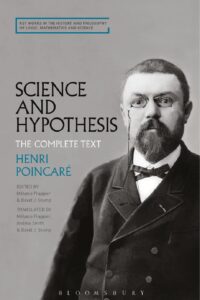
Science and Hypothesis
Poincaré
- First published
- 1902
- Author lived in
- Paris, France
- Language
- English
- Libraries
- Xenotheka
- Categories
- 20th Century, Mathematics, Philosophy, Science
- Tags
- Conventionalism, Poincare
Network
The book and its nearest company
Twenty books and twenty words that hold this book in place.
A cloud without lines: nearness is the tie. Books: the twenty Xenotheka books with the best average rank over the three spectrums together (shared words, distance on the book map, strongest concept), at most two per author; the better the rank, the nearer to the centre. Words: its distinguishing words (bold; count × rarity) and the words of its strongest cell that occur in it (italic), twenty in all; size = how often the word occurs in this book. A word is pulled toward the books that use it at least three times, and two books toward each other when one is among the other's two nearest in this group.
Links
All its faces
Rendering files: the new rendering of 14 Nov 2026 as used by Ask.Alice.
Statistics
The book in numbers
Counted as the rendering counts: lower-case words of three or more letters, stop words removed.
Most frequent words plain counts
Distinguishing words library by library
score = count in the book × ln(books in the library ÷ books containing the word); words present in at least two books; the small number is the count in the book.
| Xenotheka2143 books | poincare207 geometry270 euclidean78 hypothesis266 induction63 lorentz22 acceleration52 mathematical138 continuum71 probability108 maxwell34 ether45 equation83 theorem49 |
|---|
Faces its weight on each library's map of words
face = the book's column of the library's word-map weight matrix (2,400 cells = 40 × 60, new rendering of 14 Nov 2026), in the library's colour, brightest where the weight is highest; click a map to open the full word rendering. Words around it = the 25 words of the map that lie closest to the book: the words of its cells, taken cell by cell from the heaviest down. Owned words = the book's share of all uses of a word in the library (words used at least 8 times in the book).
Xenotheka

Half of its weight in 129 of 2,400 cells; strongest cell n2249. Click the map to open it as PDF · word galaxy
Words around it
helmholtz · faraday · gravity · acceleration · gravitate · oscillation · newton · mathematically · geometry · mechanics · symmetry · density · matrix · physicist · formalism · smoothness · gravitation · hawk · notation · wick · kinetic · flatness · normalize · periodicity · transmitted
Words it owns in Xenotheka
Spectrums
Each spectrum lines up the other books by one measure, from the closest to the furthest. The scale shows every book of the library as one dot; the five large dots are the five books on the shelf, which opens at the closest end. Scale and shelf slide together: slide the shelf and the large dots move; press or drag along the dots and the books follow, all the way to the furthest.
Spectrum 1 · Shared words
Made of the same words
Books cut from the same cloth of words, and books woven from another.
Five books the most similar faces → slide toward the least similar faces
Spectrum 2 · Map
Neighbours on the map of books
The map of books (PDF): Xenotheka
Who stands beside it on the shelf the library built for itself, and who stands at the far wall.
Five books same cell, next cells, then outward → slide toward the far end of the map
Spectrum 3 · Strongest concept
The concept it holds highest
The idea this book puts first: who else puts it first, and who never goes there.